
Echopraxia
A parable on political authority.

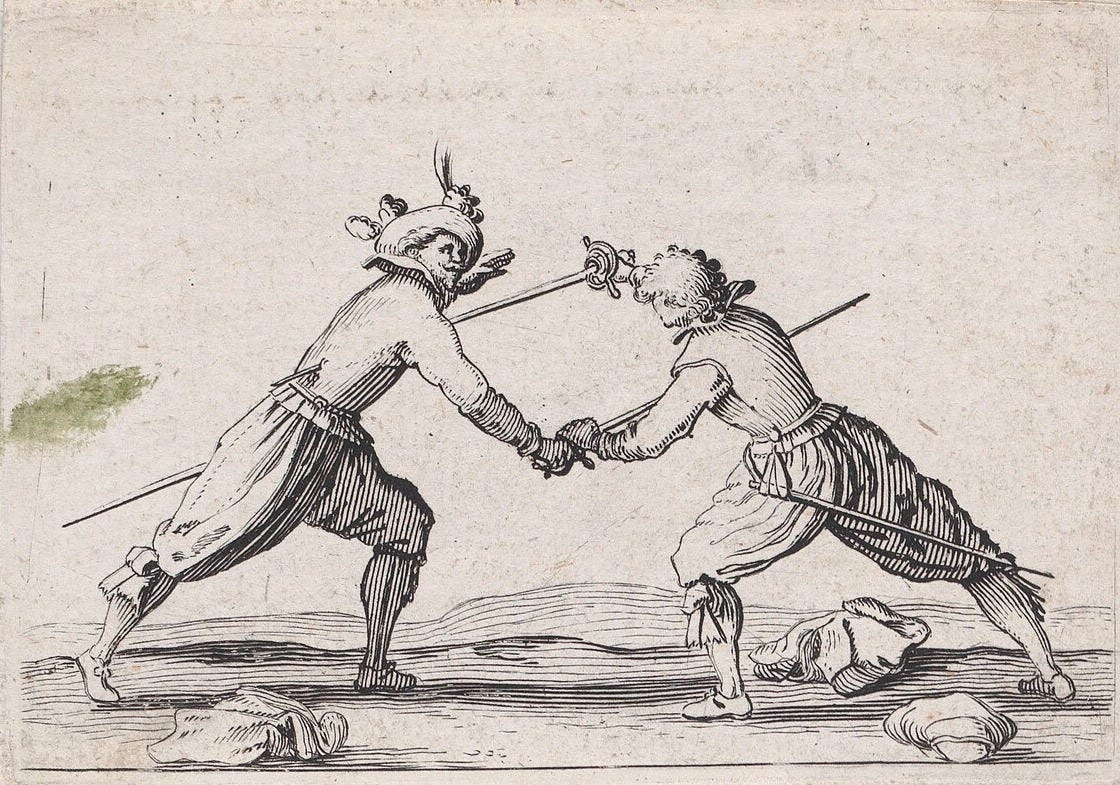
Today we have a short story I wrote in July 2023 in a single sitting and revised very lightly. As is tradition on this blog, this piece is accompanied by an essay discussing the genre concerns, formal moves and influences of the story. Previously, I said I intended to publish all of my pre-MFA short stories on Substack to empty the drawer. This is part of that effort.
Echopraxia is about a group of bourgeois revolutionaries who succeed in deposing a god-like Emperor. The Emperor possesses something of a mystical quality, and may be a practitioner of a mirroring magic (“an echopractic” in one character’s parlance) that binds his victims to mirror his will or his movements. The word itself is taken from psychiatry. Echopraxia, the involuntary mimicry of another’s actions, is a symptom of a variety of disorders; there is a subtler echopraxia in most large groups or parties, wherein the body language or gestures of the participants mirror those of the most powerful or charismatic. As political metaphor, “echopraxia” is a little obvious; but I’ve found generally that readers do not grasp metaphorized politics unless you’re extremely explicit with them, so perhaps I can be forgiven.
What’s important to note here is that this story is emphatically not about Donald Trump, or necessarily about any president. It was written during the Biden regime, and, if it has an origin in any particular political problem in the United States, it is about the cowardice of liberals who should know better than to worship the naked brutality and voluntary stupidity of their own political party. It’s hard to recall now given the disaster of Trump 2, but the Biden administration was also a disaster. Even before the regime decided to destroy its party for the sake of Israeli strategic priorities, Biden’s team spent the first half of his presidency systematically betraying every constituency he’d depended on to elect him, substituting a sanguinary war in Ukraine, a shambolic J6 Committee and Joe Manchin’s personal spending bills for meaningful reform. There was a loud insistence in the press that we all pretend Biden was the New LBJ. (He later became this by arming the wrong side in a colonial war. Biden, Biden whaddya say? How many kids did you kill today?). Swallowing such a narrative required one to be as senile as the president. Echopraxia is an indirect response then to my personal disgust with the political cowardice of my neighbors and acquaintances.
In terms of influence very obviously it draws on Gabriel Garcia Marquez’s novels and on Eduardo Galeano’s Memory of Fire and on Gene Wolfe’s conception of divine monarchy in the later half of Book of the New Sun, and on Richard Vaughan’s study of the Valois Dukes of Burgundy, especially his work on Charles le Temeraire, who was slain with a halberd on the field at Nancy after the disintegration of his grand armies in the winter of 1477. At the time (2023) I was writing a rather ponderous novel series about the struggle between the Dukes of Burgundy and their urban subjects. But then Exhopraxia is also something of an account of the pursuit and killing of the Paraguayan Emperor Francisco Solano Lopez, who led his country to complete ruin during the War of the Triple Alliance.
All very well and good. All those influences—with the partial exception of Vaughan—are in evidence in most (good) magical realist writing or SFF anyways, and therefore need little discussion.
But the most important influence is Flaubert’s Salammbo, a novel I have praised extensively on here before. (The gold chains are lifted, more or less intact, from that book). Specifically, Flaubert understood the Punic past as something purely alien to the 19th century, and worked hard to write within the Punic frame as much as he could. That Salammbo still carries a bourgeois sensibility embedded in its sexual politics and its gothic architecture is not a strike against it, but it is an artefact of that Godlike 19th century narrator so decisively killed off by the high modernists. I’m not interested in resurrecting that narrator, so Echopraxia is told in one man’s point of view, with an effort to efface the author’s opinion as much as possible.
I should say a word here on “worldbuilding.” Namely, that I am against it, almost categorically. I’ve said before that I think fantasy fiction and most sci fi should have something resembling a material basis, and I still think that’s true. But I don’t think that extends to faith, or to magic. Especially with a narrator of limited education—a squire to a cavalry colonel say—how much of their speech on the world’s function can we regard as true? What could an American lance corporal of the present generation tell you about how drones work? Enough that they would seem, to a medieval peasant, to not be magic? Surely not.
There’s been rather too much discussion in SFF forums in the last decade and a half about “worldbuilding,” and not enough about style, or about POV or other techniques. And I think from a critical perspective that it is important to reject “worldbuilding” as a meaningful analytical category. For fiction writers, the task is much simpler: if we want readers to try harder to understand our stories and our worlds, it’s time to start withholding explanation.
Without further dithering then, Echopraxia.
Echopraxia
We found the Emperor’s camp on the third morning after his army disintegrated on the pampas. He’d fled into the hills with a few score of his guard, his ministers, his courtiers, his concubines and his personal servants, there they planned to reconstitute his heavenly rule. I saw the smoke from their cook fires rising against the low range before us, ten miles distant.
Colonel Obregón scoured the hills with his glass.
“We shall ride them down,” he said. “And finish the war by nightfall.”
I came to the lancer regiment as a groom in the service of the Condesa Aguja. When she was slain, I took her horse and arms and enrolled as a servant of Colonel Obregón. There were a thousand of us then, when the Senate called for patriotic volunteers to rid them of the empire and his northern mercenaries. There were less than three hundred of us on the day we caught our foe.
Half the regiment moved north at a trot under the one-eyed, one-handed Captain Soto. We heard the rattle of their rifle fire as they pushed back the imperial pickets. It took until the very end of the afternoon to close the net.
The Emperor was on his throne when we reached him. His guardsmen, those who hadn’t fallen in the fight with Soto, were drunk. They cursed at us in their northern tongue as we rode up the valley at them. Some fired. Lancers broke from our column to ride them down.
He’d brought these mercenary guardsmen with him from across the sea. They had been the foul scourge of the people, whom they called barbarians and despoiled at will. Now we made them long for their frigid homeland. One of them, a scrawny boy of twenty, tried to stick me with his bayonet. I put my lance through his throat.
Then Soto’s riders came tumbling over the crest of the ridge, the hooves of their mounts flung up a cloud of red dust and their shouts echoed out over the hills as the last reserves of guardsmen fell before their onslaught. Obregón rose in his stirrups and waved to them, crying victory.
The fighting was over; the killing was not.
Lancers dismounted, drew their sabers and pistols and went among the tents. Some of the court officials shot themselves rather than fall prisoner. Their bodies lay crumpled in the palanquins, stripped of jewels and cloth by fleeing guardsmen. The ministers, in their black suits and neckties, died as one whole band, shot but by whom none could say. The concubines screamed as the lancers chased them. They were daughters of the great families, taken as hostages or given as gifts and they ran in billowing veils, their ankles chained with links of gold.
Five years, you must understand, we fought to cast down this court, to overthrow all that looked backwards and to restore the rule of men of dignity and honor, the rule of the Consuls. Up country, then back down, across rivers, through jungles, over the pampas, up the mountains, down to where the marshes met the sea. The Lancers of Colonel Obregón, the proud vanguard of the armies of the Glorious Republic in the war against the man who’d made himself Emperor, who believed himself a God.
Still, as I saw the half-starved riders carry the concubines from their tents, I was ashamed. The Condesa would never have tolerated such behavior from her squadron—against girls from Senatorial families no less—though she had taken mistresses from among captured peasants.
With her death all honor had passed from the world.
Through the tumult the Emperor remained on his throne, His divine cloak of multi-hued velvet and mirrors and jewels clasped yet about his pale throat. If He wept at the end of His rule, I did not see. I reined in my destrier beside the Colonel at the foot of the throne. I swung down from my saddle and touched the holy ground before the Voice of God on Earth. I’d seen Him once, as a boy during the happy years at the outset of his rule. He had processed through Aguja and the Condesa kissed the ground behind His heels and all of us prostrated ourselves before Him.
Colonel Obregón dismounted. He drew his saber.
“Citizen Valois,” he cried. “On behalf of the Senate, I have come to arrest you.”
The Emperor rose and shrugged off his robe. Beneath He wore a muscled cuirass, the nipples gold, the rest steel, polished and etched with His Oath, so that its surface glowed like the noon sun and cast words of fealty back into my head. It burned. I screamed.
The Colonel even blanched from this heavenly light.
“Remove this vermin from my sight,” the Emperor commanded. But all his ministers and all the guardsmen were dead or chained. All that remained were His personal servants in their fine silks. They pressed their heads to the ground to avoid His effulgence.
When none of His servants stirred and none of His guardsmen came, the Emperor drew the sword of Temeraire from His hip. He mirrored Obregón’s guard precisely. I feared for my Colonel then. He wore the wool jacket and linen shirt of a horseman and threadbare trousers with boots of broken leather. His lone armor was a battered helm, steel covered with brass. What could he do against the Fallen Star?
“Long Live the Emperor,” the prostrate servants cried as one. “His Glory Outshines the Sun.”
“I’ll not go,” Obregón said. “But match you steel to steel.”
The Emperor repeated his words. Obregón stepped forward, his saber in his left hand, his face expressionless. The Emperor mirrored him and transferred His blade to His left hand. Each motion the Colonel made, the Emperor made too, down to the shifting weight of His balance and the twitch of a nostril.
They did not dance as fencers will, but moved in the strange asymmetry of original and imitator. So that even when Obregón closed the distance and struck, the Emperor did not parry, but made the same thrust, and when Obregón flicked his blade back into a parry, the Emperor did the same.
No steel struck. And this touchless bout terrified me, I knew the first to strike steel or flesh must win; I was seeing devilry.
For a long minute they floated so, until Obregón broke the distance and seized the Emperor’s left hand with his right, and I could hear his flesh searing on the surface of the Emperor’s armor. The Emperor tried to grasp him in the same manner, but the Colonel struck off His free hand. Obregón stepped back and swept his blade down through the Emperor’s skull.
The Emperor’s arm mimicked the gesture without strength and His blade glanced off the Colonel’s helmet. Then He fell. Obregón stood over the corpse. The sun still shone from the steel.
Obregón made a sign to ward off evil, then drew his prayer beads from around his neck and knelt. “Join me, Escudero. He worked a powerful magic.”
I kneeled.
“Most merciful savior!” Colonel Obregón cried. “Whose flesh is given to eat, whose blood is shed to drink, whose tears are wept to wash, look on your servant now in the hour of his peril.”
Obregón prayed something long and elaborate, half in our speech and half in the speech of the Church, which made my tongue stumble. But when I dallied he seized my shoulder with his burned hand and bade me repeat his words louder and harder. All the while, the shadows lengthened and soon the belt of Venus rose in the east and darkness fell in the foothills, a red-lit shade beneath which all hearts beat forlorn.
At last he lunged forward and pried the sword from the dead hand and snapped it across his knee, as he screamed, “Out! Into the pit! Into the thorns! Into the serpents!”
I lifted my eyes from the spilled brains of the Emperor and saw the last of His servants as they rose to flee into the dusk. The armor shone no more, but was rusted in spots and smeared with dust and blood.
“Colonel,” I said. But he turned, faced east into the rising dusk, away from the blood and splendor of the camp. He walked towards the stream which had given the Emperor the water of His last meal. I followed.
The water lapped over the rocks, a channel less than fathom in breadth. I raised my canteen to my lips and strained for drops. But none came. I bent and lowered it into the stream. Cold spring water. I hadn’t had such luck in weeks. When I’d drunk my fill I stripped my jacket.
Twilight still clung to the land, pale red racing to the apex of its arc. I thought of my Condesa. She had lingered after the bullet tore her intestines open and died in the evening as the first stars glittered.
“It is over, isn’t it?”
But the Colonel did not hear my words. I knew he was lost too. His handsome face, smeared with the dust of the road and the blood of battle, streaked with the sweat of the sun, contorted for a moment in agony.
Then he spoke.
“He was an echopractic. The Emperor. It is an old magic. When they work that mirroring dance they bind the unwary to their will. But I have seen it, and know to break it. My father was one. I danced death’s dance with him too.”
“On the morrow,” I began. He ignored me.
“Then, all men are beset by echopraxia, not just the insane and the unholy. There is no freedom within it, there is no freedom without.”
I did not understand.
“He was not the real Emperor. Not to us. Not to the Consuls or the Senate. Yet for fifteen years he was. Because he found in our hearts some weakness which made men bend to the will, which formed the image of himself. Because he believed he was Emperor, he became one.”
“There are many lunatics who believe so.”
“And a few rational men,” Obregón said. “Their will is insufficient. When faced with the contest of the others’ belief, the madness in him proved the greater. All was swallowed in it. Even in the hour of his defeat, he did not quail, but stood like a God among mortals. So enthralled were his servants that they did not raise a hand in his defense. Will, Escudero, will. We are all his reflected image. Even now.”
I did not say what I thought then: that if the Emperor’s servants had been strong-willed men he might have lived, that this madness was no virtue, that we had fought to shatter this mirror. I do not know that it would’ve made any difference. For we had come so far and lost so much, and by the Colonel’s will endured and triumphed and now secured the last jewel for the Republic. Tens of thousands condemned to die by their enlistment could leave the army cantonments and return to their homes, proud that they had fought against this tyranny. By his hand they were freed. That I could’ve said.
But I said nothing. He knew or once he had.
I drank the sweet water of the stream and I talked to the ghost of the Condesa, while Colonel Obregón went to stop the lancers from looting the camp and pursuing the concubines.
When I found the Colonel the next morning with the night falling away from us in the west, he had fallen on his sword.
In death his face had lost its iron look. He was like a boy again, with a smile on his pallid lips. He lay where the stream, at the bottom of the valley, formed a pool. The surface lay still and his face rested by the water’s edge, so close he could’ve seen his own reflection.
-30-
Next week: Reading newspapers in the rain with Curzio Malaparte.