
Panic! at the Disco with the Bateman brothers
How Bret Easton Ellis establishes point-of-view

I’m back after a short hiatus with an essay about how Bret Easton Ellis constructs point-of-view in the early sections of his novels and what it looks like when his point-of-view characters reach a point of emotional rupture.
This is my big paper for the semester for Bennington. I had to grind it out in 30 minute intervals at breakfast over the last month because it’s busy season at work. It’s probably one draft away from being good, but I can’t stiff you guys for three whole weeks. Before we get into it I have some unorganized thoughts.
First, I’ve been considering doing an essay about the state of AI and about left politics at present and all that jazz. But I have to be honest, I’ve lost a lot of the energy necessary for that and it will be some time before I get it back. kate wagner’s recent essay ‘fear of breakdown’ gets at a lot of what I’ve been feeling lately. That it is too late, too late, too late. That we have lost. Yet we must struggle on against the tech oligarchy and the climate catastrophe and the Imperial state not with any expectation of victory, but because personal honor demands a rejection of AI, despondency and war.
I wonder, often, if the ambient feeling of disaster prevalent among educated Americans is akin to what Ammianus Marcellinus felt writing the Res Gestae.
Then too I’ve been writing lots of fiction, 48,000 words at least in April, 12,000 so far in May. I’ll do a summative post pretty soon recapping the whole semester, my reading and my writing and my whatnot. And I am working, finally, haltingly, on a piece about A Canticle for Leibowitz.
If you’re in the D.C. area you ought to come to Lost City Books on June 4th for the launch of Haili Blassingame’s debut novel, They All Fall In Love At The End. Haili is a good friend of mine, and she’s invited me to read a scene from my novel-in-progress, [Burgerreich Amerikkka] as part of the event. I haven’t read her book yet, but I’m excited to—though she has asked me not to write about it. Recently, Haili let me guest-star in an essay about disappearing white male writers. I intend to write a follow up piece to that, and have spoken with a couple other men who write for that piece, but it will be several weeks (months?) in the works.
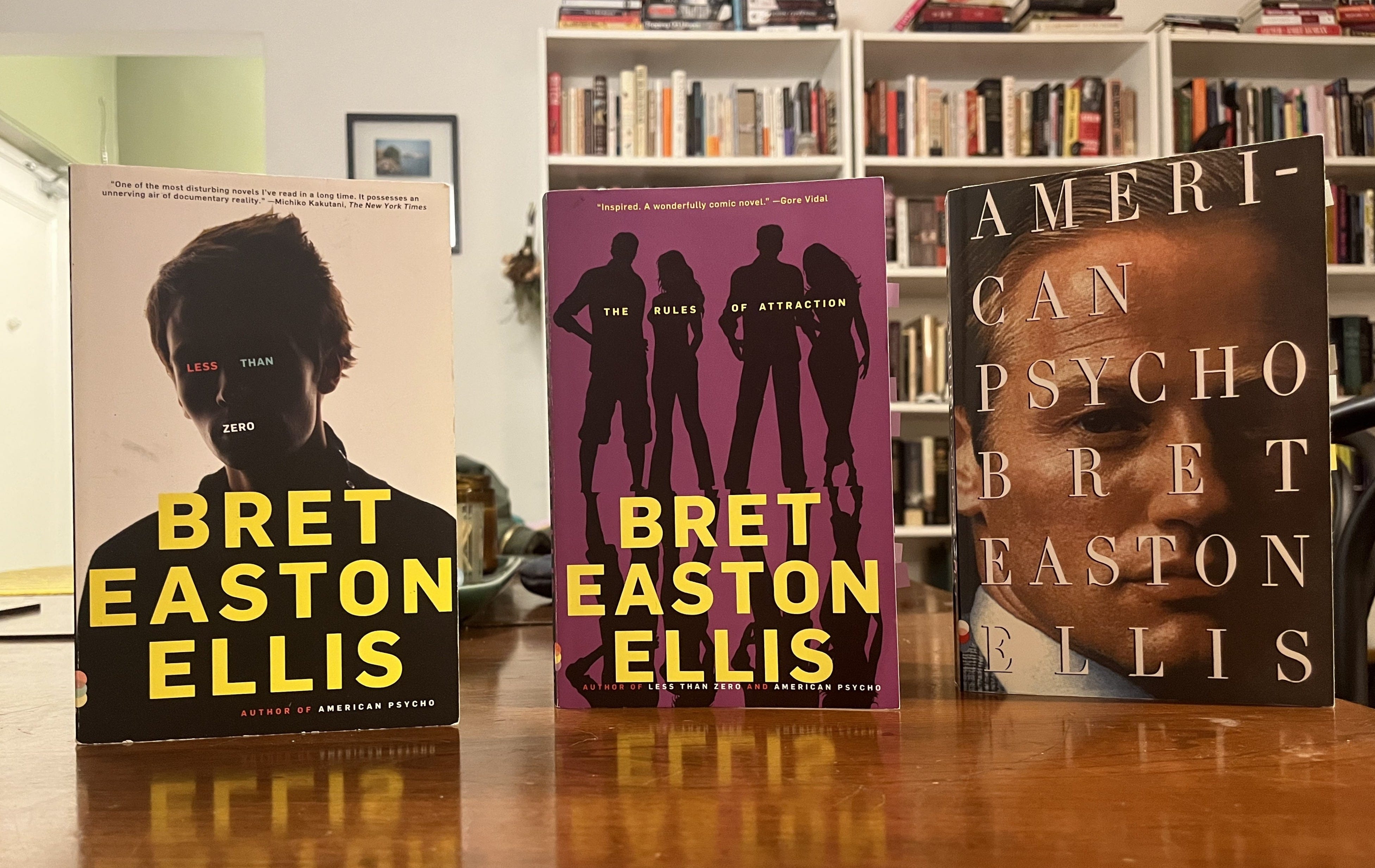
Now onto Bret Easton Ellis. I read Less Than Zero, The Rules of Attraction and American Psycho in the last year. I sort of didn’t like American Psycho all that much, the violence and the vacuity were a little too much for my delicate sensibilities, in terms of their flat profanity. Murder just gets boring. But I really liked Rules and Less Than Zero.
I also really liked, and don’t discuss in the longer essay, the sort of panicky tone Easton Ellis sometimes gives the Bateman brothers (Sean, Patrick) in these books. They’re very dumb guys and seeing them occasionally run around totally useless and freaked out about nonsense (business cards, other men, video tapes) is funny and endearing. It’s a new type of freakout for me, usually when I get down about professional competition I stare at the ceiling in brooding silence, instead of running around in a tizzy. It almost sounds fun.
But I digress, I went back to these three books and re-read them POV tricks, as you can see here:
Bret Easton Ellis’ first person methods
All this semester I’ve been working on a single novel project with three different narrators. This project poses some formal and narrative difficulties. The three characters I’m working with are all within a fairly narrow demographic band, born between 1996 and 2001, to middle class families, or families with some degree of middle class pretension, in the eastern U.S., and connected to politics.
In this way, the project bears a similarity to Bret Easton Ellis’ 1980s trilogy: Less Than Zero (1985), The Rules of Attraction (1987), and American Psycho (1989). Those three novels center on a specific generational cohort passing through Camden College—Patrick Bateman was a bit older and a Harvard man, but in any good study of a cohort there’s an odd chap out—so I’ve spent a fair amount of time thinking about how Easton Ellis establishes and uses point of view across these novels. I wanted to identify what worked and what didn’t work in Easton Ellis’ trilogy so I could get a better idea of the moves I was making in setting up the POV in my own work. At the end of this essay, I’ll discuss what I learned from these three novels and the limitations of Easton Ellis’ style.
Opening Moves
Less Than Zero starts with Clay, Easton Ellis’ protagonist, arriving in Los Angeles from Camden College for a school break. Clay’s introductory paragraph, which runs for over a page, sets up his narrative voice and major conflicts quite starkly.
The first sentence is a nonsense observation: “People are afraid to merge on freeways in Los Angeles.” (1) That is, to some extent, a statement of one of the major thematic concerns of the book: People in Clay’s Los Angeles are afraid of connection—merging—with one another. But that type of thematic wordplay is beyond the immediate scope of this essay. Clay tells us: “This is the first thing I hear when I come back to the city. Blair picks me up from LAX and mutters this under her breath as her car drives up the onramp.” This immediately establishes Clay’s narration in the first person present tense, and situates him as a conscious interlocutor for the other characters, he relates Blair’s words to us before letting her say them. Then Blair’s car, rather than Blair or “we” drives up the onramp, actions in this novel are often attributed to objects rather than to people, who remain static. Clay fixates on the meaning of Blair’s words, but can’t figure them out, this concentration excludes other thought. Los Angeles’ lack of connection replaces Clay’s somatic experience of travel (“Not the mud that had splattered the legs of my jeans, which felt kind of cold and loose…), while the characters are removed from responsibility for their own actions. Cars drive themselves and people mutter rather than speak. Nothing else seems to matter.
Further down the page, Clay’s description of his clothing doubles as an explanation of his travels, and ties back to the importance and inscrutability of Blair’s speech. Clay is hesitant to make firm judgements—this will structure most of his actions in the novel—and uses the verb “seems” five times in five sentences in the middle of the paragraph. “Seems” allows for slippage in precision, his sweater “seems” more eastern than when he put it on. His appearance and bodily experience “seems irrelevant” compared to Blair’s words, which seem easier to hear than concrete news (“I’m pretty sure Muriel is anorexic”) about his friends. And “Nothing else seems to matter to me but those ten words. Not the warm winds, which seem to propel the car down the empty freeway,” and so on. All this seeming creates a distance between the reality Clay experiences and his perception of it. The whole dramatic problem of Less than Zero is Clay’s inability to connect with other people or to translate his experiences in Los Angeles into some sort of legible somatic-emotional response.
All this is rather economically done.
The Rules of Attraction, by contrast, starts with a relatively long section that is not in first person. Instead, a character relates to the reader a story that another character, Lauren Hynde, once told. The narrative begins midstream with one very long sentence:
“and it’s a story that might bore you but you don’t have to listen, she told me, because she always knew it was going to be like that, and it was, she thinks, her first year, or, actually weekend, really a Friday, in September, at Camden, and this was three or four years ago, and she got so drunk that she ended up in bed, lost her virginity (late, she was eighteen) in Lorna Slavin’s room, because she was a Freshman and had a roommate and Lorna was, she remembers, a Senior or a Junior and usually sometimes at her boyfriends place off-campus, to who she thought was a Sophomore Ceramics major but who was actually either some guy from N.Y.U., a film student and up in New Hampshire just for The Dressed to Get Screwed party, or a townie.”
That’s 142 words and I think about 19 commas, which feels a little excessive. But what we get here is a sort-of establishing point for POV (“she told me”) that then immediately shifts into something of a thesis statement for the novel: Camden is a college where time and people bend recursively back into themselves. Lauren Hynde cannot remember the year, necessarily, in which she lost her virginity, the experience is lost in an eternal present-past in which action recurs, again and again, in echoing, distorted form. It also marks an escalation in intensity compared to the opening of Less Than Zero. Easton-Ellis spends the first three pages of this novel relating a graphic rape, which is never really acknowledged in those terms. Lauren Hynde, whose story the narrator is relating, later acts as a point of view character, but here her voice is mediated and her memory presented more coherently than is typical of the rest of the novel. Elsewhere, Easton Ellis uses transitions between first person POVs and tenses to fracture time, create a sense of immediacy, and distort the emotional weight of events. Easton Ellis is once again using the very start of the book to pose the thematic concerns of the novel, albeit in a less word-play manner than in Less Than Zero. We get sexual violence, drugs, dissolution of identity, and the difficulty of missed connections. Rules is about the unknowability of other people and the failure of intoxication and desire to facilitate that knowledge. Easton Ellis literalizes that thematic concern on the first page: Lauren is incapable of identifying the guy to whom she lost her virginity.
He also uses this passage to construct much of the setting: academics are secondary to hedonism at Camden, where drug use is common and where personal property gets a little blurry. People spend a lot of time fucking in other people’s rooms in this novel.
A few pages later, Easton Ellis shifts to the narrative voice that defines the rest of the book: alternating first person POV sections from various Camden college students. Sean Bateman, Paul Denton and Lauren Hynde emerge as the primary narrators, but there are several others, including a francophone character and a girl who writes metatextual love notes that Sean Bateman mistakes as being from Lauren.
Easton Ellis typically labels these sections with the narrator’s name. This makes it easy for the reader to mark perspective shifts and differentiate voices. The shift into Sean’s POV after the first three pages has a nice clean break with the running sentences and fragmented interiority of the opening. “The party is starting to end. I get to Windham House right when the last keg is being tapped. The deal in town went okay and I have some cash so I buy some weed from this Freshman who lives in the cardroom in Booth and get high before coming to Thirsty Thursday.” In this graf Sean Bateman introduces himself as a drug dealer and we get the simplicity of most of his thought process: He has cash, he buys weed. Later he’s horny, so he tries to get laid.
American Psycho also takes several pages to slip into the narrative flow. The first graf, despite being Patrick Bateman’s personal narration, is indistinguishable from a limited third perspective:
“ABANDON ALL HOPE YE WHO ENTER HERE is scrawled in blood red lettering on the side of the chemical bank near the corner of Eleventh and First and is in print large enough to be seen from the backseat of the cab as it lurches forward in the traffic leaving Wall Street and just as Timothy Price notices the words a bus pulls up, the advertisement of Les Miserables on its side blocking his view, but Price who is with Pierce & Pierce and twenty-six doesn’t seem to care because he tells the driver he will give him five dollars to turn up the radio, “Be My Baby” on WYNN, and the driver, black, not American, does so.”
This is another long sentence, 117 words by my count, but it is both more coherent and less eventful than the opening of Rules. Price’s biographical information and visual point of view are details, while Easton Ellis introduces the tongue in cheek textual references that will pervade the rest of the book. More than thematic stakes, this opening establishes the stylistic toolbox Easton Ellis uses in American Psycho. Patrick Bateman, son of his class, merges with the rest of Wall Street at times, to the point that his murders and criminality are not meaningfully distinct from jokes. He and Price see the same things. The narrative voice establishes the artifice of violence: “blood red lettering” could be an advertisement, could be graffiti, but it distinctly is not blood. The reader doesn’t get a sense of Bateman’s existence until Price says “I hate my job, you’ve told me you hate yours,” deep in the second graf.
Bateman’s first intervention in the narrative occurs on the second page, when he reminds Price that Price’s house in the Hamptons is really his parents’ house. Bateman’s narrative voice then immediately mistakes the Crystals for the Ronettes, and goes on to characterize Price’s belongings, “expensive-looking Walkman,” “Tumi calfksin attache case,” and “six-button wool and silk suit by Ermenegildo Zegna,” and so on. For several pages, Bateman plays the detached narrator while Price rants about how much he hates many of the people who live in New York and counts the homeless people they pass. The reader understands that Bateman is leaving the cab, traversing the sidewalk and so on because Bateman functions as a camera on Price’s shoulder, narrating his actions and primarily providing commentary on the consumer products of the people Price encounters. Bateman doesn’t do anything until the sixth page of the novel, when he shivers and hands a woman his Armani overcoat. It’s a more extreme version of Ellis’ burying the lede maneuver from Rules.
The greater similarity, however, is with Zero, which also begins with a car ride. Both car rides serve as establishing shots traversing a specific urban geography: The emptiness of Clay’s Los Angeles, versus Price/Bateman’s nightmare Manhattan. The narrative voice blends together, with Price’s monologue overwhelming and replacing Bateman, whose passivity (“Price waits for a reaction. There is none.” (6)) makes him an extension of Price. They share similar concerns with crime and violence. Price expresses them in overwrought terms: “let the fucking bitch freeze to death,” (6) while Bateman’s commentary is more restrained: “There is a moderately interesting story concerning two people who disappeared at a party aboard the yacht of a semi-noted New York Socialite while the boat was circling the island.” (5) As with the non-conversation between Clay and Blair, Price and Bateman’s interaction sets a narrative baseline—incomplete detachment from the observed world. Bateman’s function as a purely receptive character in the chapter is shown by Easton Ellis’ use of filmic metaphors: “Smash cut and I’m back in the kitchen” (11). Later this merging of identities between bankers will make it possible for Bateman to get away with, or imagine himself getting away with, murder.
American Psycho’s is the slowest of the three openings, lacking the immediacy of Rules and the comic concerns of Zero. In my opinion, it makes American Psycho a little boring at the start, but the banality and the boringness of the Wall Street set, as with the flighty emptiness of Camden, is part of the collective moral project of these three novels, which is to posit hollow worlds and then try to fill them. In American Psycho, the world fills gradually with Patrick Bateman’s narrative voice, and the back half of the novel is full of his digressions and impressions, in a break with the style and technique of earlier Easton Ellis.
But what happens when these narrative voices reach an emotional or perceptual breaking point?
Breaking the glassy affect
Easton Ellis’ novels escalate in terms of narrative intensity, with the climactic moment, or moments, defined by shifts in the degree of interiority shown to the audience. Here’s how that plays out in Less Than Zero, a book so dedicated to its narrator’s emotionally numb affect you could characterize the narrative voice as an anti-stream of consciousness. Feeling is largely dammed, insight absent, and the narrator’s opinion on the events around him have to be inferred from his actions (leaving a particular party, for instance). One has little sense of Clay, the narrator, as an embodied individual; there’s an element of the screenplay to Less Than Zero, part of what makes it a consummate Los Angeles novel..
But very late in the book, during a conversation with his sort-of ex-girlfriend, Blair, Clay gets a rare moment of insight:
“So you’re actually going back to school,” [Blair] says.
“I guess so. There’s nothing here.”
“Did you expect to find something?”
Like I’ve been here forever.
I quietly kick my foot against the terrace railing and ignore her. It is a mistake. Suddenly she looks at me and takes off her Wayfarers.
“Clay, did you ever love me?”
I’m studying a billboard and say that I didn’t hear what she said.
“I asked if you ever loved me?”
On the terrace the sun bursts into my eyes and for one blinding moment I see myself clearly. I remember the first time we made love, in the house in Palm Springs, her body tan and wet, lying against cool, white sheets.
“Don’t do this, Blair,” I tell her. (203)
In an earlier essay, I did a close reading of that passage, focusing on the shifting intensity of the verb choices, and the rhetorical role of “her body tan and wet,” which is half a line from The River, by Bruce Springsteen, a much more earnest song than Easton Ellis’ usual New Wave fixations or the titular Elvis Costello track. But I didn’t talk much about the interiority of this scene.
This passage gradually moves into Clay’s head, starting with the italicized sardonic comment and the analytical intrusion: “It is a mistake.” These are followed by two key moments: “On the terrace the sun bursts into my eyes and for one blinding moment I see myself clearly.” and the use of “made love.” The question of real love is serious enough to jolt Clay out of his disaffection. Love for Blair is the only force that seems strong enough to tie him to Los Angeles. But there’s an irony in the sentence construction: The sunburst makes him see himself, or at least his own desires, clearly, but he doesn’t tell us what he sees. Instead his gaze shifts to an erotic appraisal of Blair’s body. But, where much of the sex writing in Less Than Zero (and all three novels) is technical or profane, the verb choice here is sentimental: “made love,” one of a handful of times this phrase is used in the book. We can also read “made love” in an overly literal fashion: the sexual encounter with Blair is a process of the production of that “love.”
But what does Clay see when he sees himself clearly? Judging by his begging request to break off the conversation, I think he sees the moral sweep of his actions in the novel, their inadequacies, and he sees also a time before the depravities of the book, when he was still capable of love. But Easton Ellis refuses to explicate insight into the character.
It takes a lot to break through the reflexive anomie of Easton Ellis’ protagonists, but much of the project of The Rules of Attraction is testing what, precisely, can do that. (It’s abortion, because for all his pretense to the avant garde and the picaresque, Easton Ellis, here at least, is working in the tradition of the bourgeois novel of sentiment, but I digress.) Throughout Rules, Easton Ellis mostly maintains the distanced, ironic and glib narrative style across his narrators. A small passage can stand in for the general tone of the text: “The hippie kept telling me I was too stiff, too uptight. And because of this the hippie and I broke up before the end of term. (I don’t know if that’s the real reason, but looking back it seems weird that we even bothered since the sex was so good.)” (95). What interiority is present is undercut by the narrator’s lack of self-awareness; commentary on character is presented flatly, with little emotional reflection, and potential moments of insight are vitiated by flashes of hedonic stupidity.
This general scheme breaks down only at the end of the novel, when Lauren realizes she is pregnant and she and Sean Bateman go to New York, sort of almost elope, and then drive around New England until Sean agrees to pay for an abortion.
In New York, they visit some of Bateman’s friends, who talk about how much they like Phil Collins. Lauren looks at Bateman: “Sean sat there impassive, his face falling slightly. And though it was at that moment that I realized I did not love him and never had, and that I was acting on some bizarre impulse, I was still hoping he was thinking the same thing I was: I don’t want to end up like this.” (257) Hynde’s realization is prompted by Bateman’s own response to his friends. Those Phil Collins Yuppies love each other and have a perfect contentment in their own, small world, but Hynde and Bateman both don’t want that. There’s an intense sadness to the realization, but it is also the first time that the two characters—who have spent the novel mishearing and misreading each other—actually have some understanding of the other’s position. Their relationship is over, but its end makes it possible for them to see each other as real people. Hynde that night has a dream of married domesticity that is “unpleasant but not unbearable and in some indefinable way I felt safe.” (258) The dream’s mediocrity and safety seem to be a source of discomfort.
They avoid talking about Lauren’s pregnancy, or Sean’s impulsive marriage proposal, but the realization in New York pushes them into aimless wandering. Lauren describes the week using an indefinite timeframe: “He would slow down the car if we passed anything even remotely resembling a chapel.” (262) “Would” makes the actions generic and repetitive, their week of wandering becomes a succession of days in which the same emotional beats play over again.
But for Bateman, the realization shifts him into a more definite reality, and when we resume with his POV, Easton Ellis writes: “All of the trees were dead. There were dead skunks and dogs and even an occasional deer by the side of the road, their blood staining the snow.” (263). The desolation of the physical landscape reflects the emotional deadness of Sean Bateman. Later in the same passage he is unable to identify why certain songs make him sad. Easton Ellis repeats the indefinite ‘would’ timing, so Bateman’s scheme to leave Hynde at a hotel without saying anything becomes a repetitive and unending betrayal. Even the final sentence of the graf trails off into an indefinite listlessness: “It would get dark at four in the afternoon, the snow drifting over the rise and fall of the countryside.”
When Bateman finally, in the next graf, reaches an epiphany, it is muted, triggered by looking at Hynde: “While she went to the restroom and was coming back, trudging through the snow, approaching the car, after throwing up, something clicked. The snow on the windshield started to melt.” The repeated -ing sounds in that sentence, also help create an extended present, drawing out Hynde’s return beyond the ten or twenty seconds it takes to cross a parking lot. She’s out there long enough for the snow to start melting, continuing the parallelism between external despair and internal blockage. The feelings start to flow like snowmelt. Bateman never tells the reader what clicks for him, a sense of honor or a sense of disconnection, or one of heavy responsibility. In any case, he offers to pay for Hynde’s abortion. The sequence leading up to the abortion is the part of the novel where Easton Ellis reaches for the imagistic, and where the external world intrudes on the idyllic hedonism of Camden College. It is also the sentimental heart of the novel; none of the characters in Rules are particularly active, in the sense that they do very little to alter the structural forces of their lives, but that roadtrip is the major exception, when Lauren and Sean try to escape from the repetitive ‘woulds’ and the eternal present of the ‘-ing’ present participle, and make real, if limited personal overtures. Their failure to establish a connection in anything save the negative sense dooms their connection. They know they don’t want each other. They don’t know anything else.
American Psycho, with its looping actions, its characters who meld and merge, and its unclear reality, is also a novel of the eternal present. While Patrick Bateman is a hollow character, and similarly out of touch with his desires, Easton Ellis gives him a much more developed inner world. Late in the novel, during a conversation with Jean, his secretary, Easton Ellis has Bateman describe his internal state in a monologue to the reader. This is triggered by Jean’s ignorance of Ted Bundy. Bateman says: “where there was nature and earth, life and water, I saw a desert landscape that was unending, resembling some sort of crater, so devoid of reason and light and spirit that the mind could not grasp it on any sort of conscious level,” (374), this continues for a lengthy paragraph. The graf alternates lengthy discursive sentences with shorter declarative ones: “Sex is mathematics.” and “Reflection is useless, the world is senseless. Evil is its only permanence. God is not alive. Love cannot be trusted.” (375). The imagery at the start of the paragraph and the short sentences both bear a resemblance to Sean Bateman’s apprehension of the outer world in the abortion sequence in Rules. But Easton Ellis reverses the external world as a signifier of the character’s feelings; Patrick’s inner world is the dead world, and he is conscious that he projects this inner landscape onto the outer world. It is, I think, more interesting for Bateman to construct an internal psychogeography than for the world to be shaped to his inner-feeling; however, Easton Ellis still makes New York, or parts of it, a mirror of Bateman’s depravity, through the press and through the concerns of Bateman’s peers. There’s little difference from the world laid out by Timothy Price on page 1 of American Psycho and the monologue given by Patrick Bateman.
In contrast to Less Than Zero and The Rules of Attraction, American Psycho has a number of moments of direct, first person narrative crisis, where Patrick Bateman’s internal processes take over narrative control of the story. Some of the murder scenes—the shooting of the saxophone player and subsequent police chase—take on the feeling of a dream, or of a memory of an action movie. After the inner landscape monologue, he accomplishes what Clay does not, and tells the reader how he sees himself:
“there is an idea of Patrick Bateman, some kind of abstraction, but there is no real me, only an entity, something illusory, and though I can hide my cold gaze and you can shake my hand and feel the flesh gripping yours and maybe you can even sense our lifestyles are probably comparable: I simply am not there.” (377)
Accepting Bateman’s asserted non-existence requires discarding the rest of the novel, saturated as it is in his narrative voice. But it does recall something of that extended first scene, where Bateman emerges gradually in reaction to Timothy Price’s conversation. Patrick is a reflection of his class, even his imagined reader is part of the same small group. The other way to read this particular monologue is that Bateman is asserting his own fictionality. Easton Ellis’ love of irony undergirds this reading: Bateman defends his embodied existence by denying his inner existence, despite the emergence of that existence out of the novel. However, I find that degree of metatext aesthetically annoying.
Easton Ellis averts a real narrative conclusion to Patrick Bateman’s story in this book. Bateman continues dining with the other bankers, at the edge of sanity and reality, on and on in his own perpetual present. This is part of what I find boring about American Psycho, and why, in revisiting its key passages for this paper, I often found myself more hostile to the book than to Rules or Zero. In those novels the commitment to a specific style makes even small departures from it feel significant, while American Psycho’s more discursive, heterogenous construction makes it feel more like a book in which things ought to come to a head.
Yet they do not.
What I liked, disliked and took away from these books
Overall, I think Easton Ellis’ early novels are uneven. In terms of pure experience, I had the most fun with Less Than Zero, and I thought The Rules of Attraction was the funniest, while American Psycho is the most stylistically and mechanically mature.
The emphasis on Patrick Bateman’s depravity bored me, and the more I revisited American Psycho the less interest I had in the eruptions of violence and the occasional passages of explicit psychologism. Not in the sense that they’re offensive, but the story works once, maybe only once, before the neuroses and the idiosyncrasies and the questions of Bateman’s reliability stop being interesting. American Psycho’s tension comes from Bateman’s psychosis’ intrusion on his functioning as a yuppie banker. Questions like ‘will he get away with being crazy?’ ‘is he even actually crazy?’ and ‘is he a fragmentary composite of the id-desires of the rest of Wall Street?’ stopped being sources of tension for me once I’d finished the book. It’s not a novel that, in my opinion, rewards close attention to aesthetic detail with any degree of readerly pleasure.
The other two books, being more self-consciously youthful, just feel more fun. I really do think, in Less Than Zero’s case, that this comes down to Easton Ellis’ consummate refusal to let Clay tell the audience anything directly. His position on events is visible as the shadow of his accumulated fixations, evasions, dreams and failures, a gestalt impression of the vacuous interior.
The Rules of Attraction has some of the embryonic elements of American Psycho’s style, the paratextual insertions of the love notes, for instance, and Easton Ellis’ male narrators have the same type of panicked response to external problems or misunderstandings that Patrick Bateman has. Its subject matter, the College Experience under high Reaganism, is well-suited to this style.
As for what I learned, at the craft level, from reading these three books, I was mostly impressed by the economy with which Easton Ellis establishes the basic style of his books. The tone, narrative distance and thematic concerns of Less Than Zero and Rules are evident from their very first paragraphs, while American Psycho manages the same process over a couple of pages. I’ve struggled this semester to achieve a similar synthesis of style, content and form in the first pages of my own novel project, and I’ve been thinking about the sentence-level choices Easton Ellis makes during those opening pages.
One limit to that economy, and one place where American Psycho diverges from its predecessors, is that those first two books feel like exercises in style and tone. There’s not much that happens in them, and the decisions characters make impact outcomes only arbitrarily, with confessions, confrontations and actions lost in the flow of confusion, that morass of the eternal present. American Psycho tries to marry a greater focus on events with the same centrality of style, but doesn’t quite commit itself to the supremacy of one choice or the other, which I think contributes to its muddled feeling on re-read. To some extent, this is imposing a false dichotomy on American Psycho—there’s not necessarily a tension between the eventfulness of a book and its commitment to an overt style. But the reality-undermining aspects of American Psycho also undermine the immediacy of its present-tense narration and the feeling that any of it is actually happening.
-30-