
Please don’t Nuke me
Everything there is to say about "A Canticle for Leibowitz"

Last year, when I was staying at a haunted hotel for a business conference, I started reading A Canticle for Leibowitz.
Flying into Chicago that first night there was an apocalyptic dust storm, a great beige bank of nothing seen from the plane, with red lightning roiling in the suspended sand. It was the first severe dust storm there since Roosevelt was president.
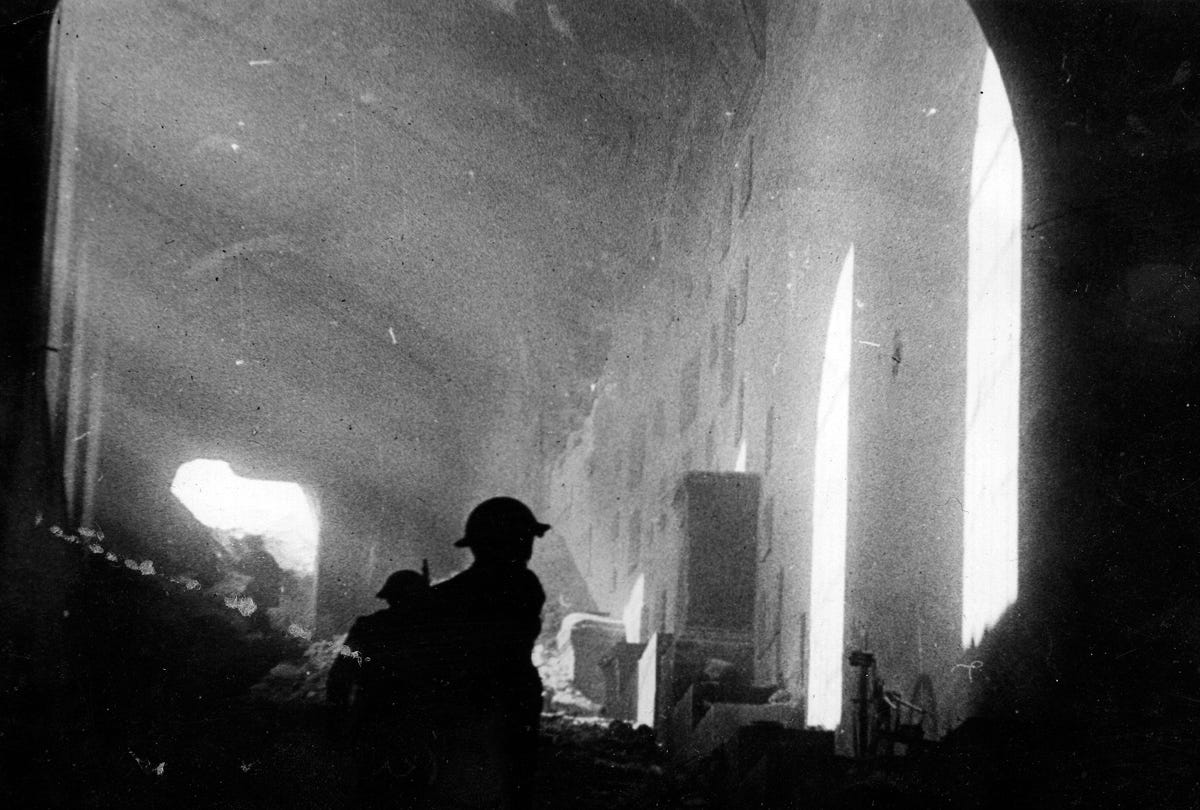
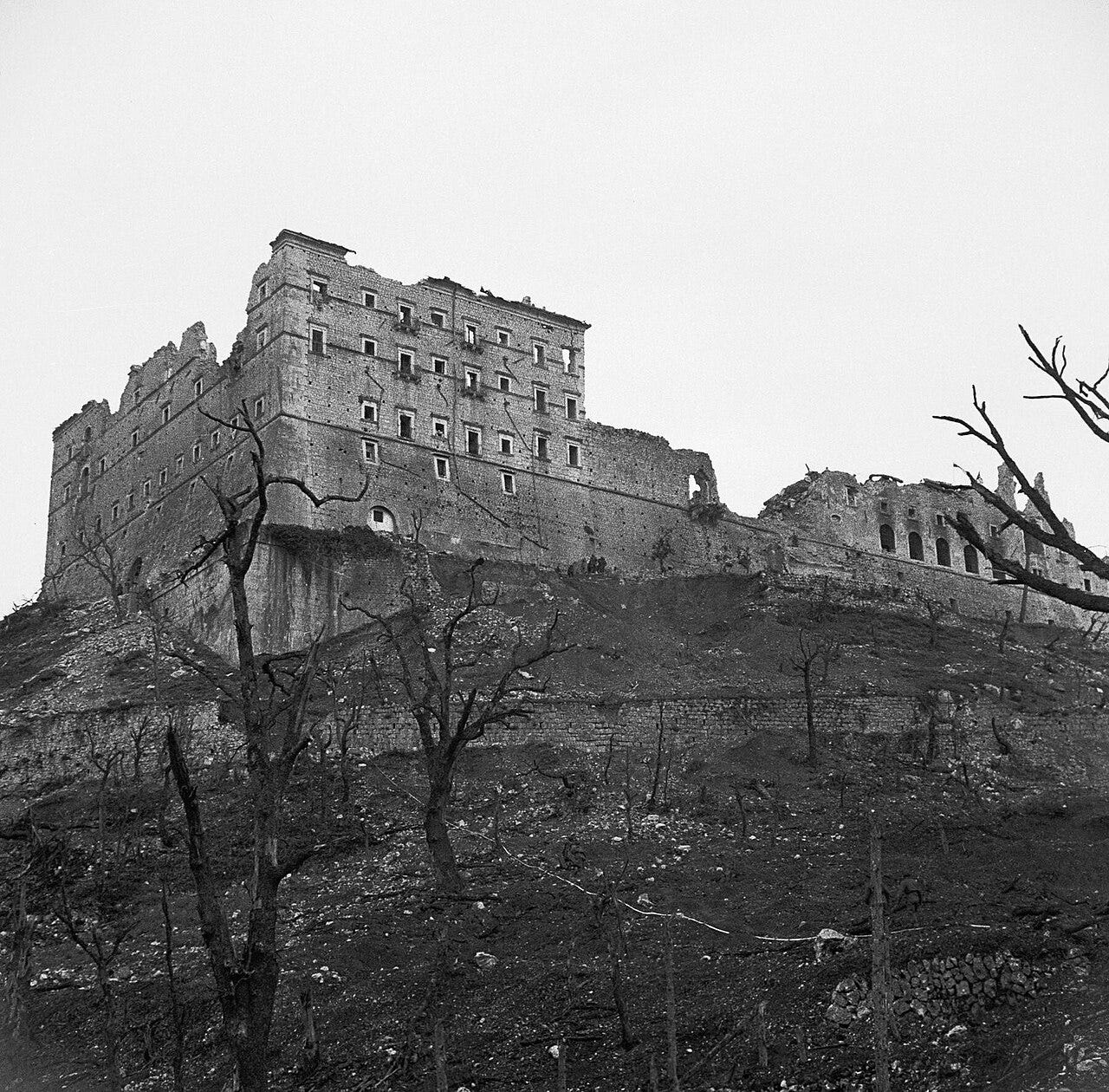
Roosevelt gave us The Bomb and The Bomb gave us Leibowitz by way of Walter Miller Jr., who helped blow up the oldest monastery in Europe for the U.S. Army Air Corps and apparently felt very bad about it. But in the plane over the plains I wasn’t thinking about The Bomb, I was thinking about how I was being forced to work on my birthday and reciting the bits of doggerel I recite to myself in troubled aircraft: Tolkien, the Shahada, a little bit of Eliot.
For whatever reason then I was extra receptive when, later that night, I started reading Leibowitz, a midcentury sci-fi novel about a bunch of Catholic monks who, over the span of 18 centuries and three novellas, painstakingly copy out the remaining texts of a society destroyed by nuclear war. The renaissance made possible by their thankless labors reproduces first Empire, then Electricity, then The Bomb, and then Universal Ruin. Some of them are eventually dispatched to space to carry on their order’s purpose on extra-solar colonies.
I read the physical text, but I also listened to the audiobook as I walked from my hotel to the convention center, alone in the cold Chicago mornings, and at night when I went to the Taco Bell behind the public library. I would listen and walk. Nothing else mattered in my days.
I’ve been thinking about this book and its monks for over a year now, to the near-exclusion of anything else. In the fall, I re-read it, and this month I re-read it for this essay. I’ve read it more times than any other novel I’ve read as an adult. I quote passages from memory to my co-workers and friends. I’ve become the Guy Who’s Only Seen Boss Baby about it. Whenever I finish a book or a movie I compare it to Leibowitz before anything else. It’s not, I must say, my favorite book, but this is the first time in a very long time that I’ve been so wholly dominated by a book. This Effort Post is really two mirrored essays to come out of that obsession, one about the dark and troubled waters of the past, the second about the bright and terrible flames of the future.
If I had started this book another time, I don’t think I would have been so profoundly affected by it. But there is something depressing about big business conferences; to a reporter they are anthropological exercises. I participate, I see, I speak, but I am not of them. I am condemned to wander and to witness. I felt like a ghost in the McCormick Center, I felt like old Benjamin Eleazar, a version of the Wandering Jew myth reproduced by Miller. Everyone in the conference center, all 60,000 executives, comms flacks and provincial rubes, kept burbling and babbling about AI, and all I could think was Benjamin’s line from one of his debates with the Abbots of the order of Saint Leibowitz: “You fish in dark waters.”
Three weeks later we went to war with Iran.
1a. Can kraut, six bagels—bring home for Emma
There are all sorts of missing pieces in Leibowitz. The novel is defined by this problem: The past survives in only incomplete form. And I can’t stop thinking, in particular, about Isaac Edward Leibowitz’s wife, Emily, and her death in a nuclear war in the late 20th century—the Flame Deluge.
The Abbey of the Leibowitzian order lies somewhere in the dry hills west of the Rocky front ranges, astride the road from Texas in the south to Utah in the northwest. Its geography is somewhat unclear. The Abbey is built in a high valley, probably somewhat north of Albuquerque. What matters, in the first novella some 600 years after a nuclear war, is its remoteness from the coasts and the easily tilled plains—it cannot be hastily assailed by the enemies of literacy.
Some parts of the abbey are made of stone and concrete cannibalized from the remains of a U.S. city or military installation once constructed there.1 The buried traces of the atomic age surround the Abbey, and one of these, the ruined entry of a fallout shelter, sets the plot in motion.
A young novice out for a lenten fast encounters Benjamin Eleazar, our wandering Jew, in the ruins. Benjamin marks a stone for the boy to use in his shelter and when the novice, Francis Gerard of Utah, shifts the stone he finds the buried fallout shelter and with it the personal papers and dead wife of the blessed Isaac Edward Leibowitz, an American nuclear scientist in the 20th century who converted to Catholicism and founded an order of monks after the war. These monks—bookleggers and memorizers—smuggle and then reproduce what texts they can save from the apocalypse.
The papers and the skeleton found in the fallout shelter prove key to the case for sanctifying Leibowitz — the Devil’s Advocates have maintained that Leibowitz was still married when he was ordained, years after the Flame Deluge, and that this invalidates both his priesthood and his possible canonization.
The question of Leibowitz’s marriage, his renunciation of Judaism, even his actions in founding an order to preserve the written word, are not as interesting to me as this question of his wife’s tomb. Emily (Emma) Leibowitz was not on the priority list for a fallout shelter, though Isaac tried to get her on one, according to the notes found with her body. She died in the antechamber to the shelter when the city was bombed, crushed by the fall of the building above her; the same stones which pinned her fixed shut the door of the shelter, so the people within starved or suffocated or died of dehydration.
I wonder about the timing. How long was she waiting in the antechamber for the bomb flash? Had she just reached the door, unable yet to present the note from Isaac that would’ve gained her entry? Or was she made to wait for hours for the nuclear strike? Did she know he was jetting off somewhere for a discussion of the war? In any case, she died holding his toolbox.
Her remains are identified by the possession of that toolbox and the presence of a gold tooth, which the monks know she had, “one of those historical trivialities that manage somehow to outlive important facts which someone should have bothered to remember.”
That gold-toothed skull is the first big sticking point in the book, the first (of three or sort of four) women to play a significant role in the story and she’s dead and mute from the start, important only because she is dead and mute.
During a section on the outbreak of the nuclear war, Miller tells us that Isaac Leibowitz failed to find his wife in the immediate aftermath of the war, and survived by hiding out with Cistercian monks, who protected him from bands of “simpletons.” The simpletons were parading around killing people who could read in order to prevent the reconstruction of a society capable of building The Bomb. After some years with the Cistercians, Leibowitz went “once more to search for Emily or her grave, in the far southwest. There he had become convinced at last of her death, for death was unconditionally triumphant in that place. There in the desert he quietly made a vow.”
When brother Francis finds Emily’s body, he thinks “this underground ruin had been touched by no hand but the hand of impersonal disaster,” for six hundred years. But do we believe this?
I don’t. Why did Leibowitz make his vow in the desert so near to the shelter that holds his wife’s remains? What does it mean for death to be triumphant? Why is the Leibowitzian Abbey where it is? Why does Benjamin Eleazar, who knew Leibowitz, mark the specific stone that closes Emily’s tomb?
The limited reading is that Leibowitz returned after the war to see the waste of his old city, and finding the fallout shelter buried, concluded Emily was dead. He selected the hinterlands of the ruined city for his abbey because it was defensible and inaccessible to the simpletons going around burning books and killing the learned.
But all throughout Canticle’s three novellas, characters are busy stumbling into dark holes where they find remnants of the 20th century.
These fragments of the 20th century are sometimes legible to their discoverers. Leibowitz himself is one such living fragment: A Jewish guy born in or just before The Great Depression, too young to have fought in the Second World War, but just old enough and secular enough to see in the survival and prosperity of America a post-Armageddon Kingdom, the Republic of Heaven on earth.
Other bits of that Republic survive: A six lane highway buried under shifting desert sands, a grocery list in Leibowitz’s hand reading “Pound pastrami, can kraut, six bagels– bring home for Emma,” and Leibowitz’s circuit diagram “Transistorized Control System for Unit Six-B,” which Francis spends 15 years reproducing as an illuminated parchment.
But those looking for the past go fishing in dark waters indeed, and what they find often destroys them. Boedullus, a monk mentioned several times in the book as an active searcher for the past, took an expedition into the desert about eighty years before the events of the first novella (Fiat Homo) and there found “the site of an intercontinental launching pad, complete with several fascinating subterranean storage tanks.”
One of the ICBMs in those subterranean storage tanks was still armed and nothing is heard from Boedullus after the discovery. The monks, the launching pad and a nearby village get vaporized and shepherds divert a stream into the crater, which is rumored to host a giant catfish, bo’odollos. The pieces of the 20th century retain their ability to destroy and to entrance, they are deep pools, still waters, in which men see what they fear most, or what they need most to be true.
Emily Leibowitz, Emily of the dark waters as we might call her, is the first of these voids. Her death makes a man a saint, her life reduced to a gold tooth and to possession of a toolbox, her grave forgotten by everyone save old Benjamin Eleazar, for whom it holds little significance. For Benjamin, the travails of monks and even the dramas of the Flame Deluge are all so much uniformly remembered tragedy: “a burden impressed upon every generation before the opening of the womb, the burden of the guilt of original sin,” as the Abbot Dom Paulo thinks in the second novella (Fiat Lux).
1b. The Tedium of Life
For a long time the material of life is primitive, even primordial, and “in a dark sea of centuries wherein nothing seemed to flow, a lifetime was only a brief eddy, even for the man who lived it,” so the narrative voice tells us.
But when the sea begins to heave again, the dark stillness of the past—Bo’dollos the Catfish and Emily Leibowitz and the fragments of the memorabilia preserved by the monks—is equally seductive and shameful to those for whom time has become precious.
Thon Taddeo Pfardentrott (lol) dreams of rediscovering the power of an ancient civilization and, 1,200 years after the Flame Deluge, he travels from Texarkana (an earthly New Rome to accompany the church’s New Rome (Pittsburgh)) to the Leibowitzian abbey to review the pre-Deluge documents held by the monks. The Thon—an honorific implying an educated nobleman—is the cousin of the Mayor/Emperor of Texarkana and is the structural antagonist of the Leibowitzians. He wants, for example, to transport the memorabilia from their cellars to his Collegium in Texarkana and there integrate it into the imperial researches commissioned by his cousin. The Collegium is a clear parallel of the Institut de France (or Richelieu’s preceding Academie Francaise), serving to glorify and expand its empire through scientific research.
Taddeo, however, is so disgusted with the tedium and poverty of daily life that he invents fanciful theories to make his era special. He becomes obsessed with a hypothesis that mankind is not “the lineal descendent of men who supposedly invented machines that flew, who traveled to the moon, harnessed the forces of Nature, built machines that could talk and seemed to think.” Instead, Taddeo posits, contemporary people descend from a race of servants created by Man.
Taddeo’s textual research at the abbey is part of an effort to prove this, while another Thon works to synthesize living matter from a handful of basic ingredients. The Thon’s obsession with the past is an effort to free himself from the burden or original sin and to assert the originality of his civilization against the previous civilization. A pure civilization, born not from corrupted man but from a synthetically designed protoplasm, would be free necessarily from the covenants of its creators and also from their limitations.
The reverse side of this proposition is that such a people would be free too from the shame and responsibility of the Flame Deluge. The relics of the 20th century would not be theirs to mourn. Their present poverty could also be excused by their design as subordinates. Having inherited nothing, the new man would be free to create the world again in his own image. The monks reject this, and Miller goes to great pains to state textually that Thon’s proposition is based on a misreading of satirical fragments.
Man does, inadvertently, create a sort of new life. But it is in those dark and stagnant waters, and not under the lights of the new Collegiums.
Fallout has damaged the human genome considerably, resulting in mutations among a significant portion of the population. One such mutant is Mrs. Grales, (like the Holy Grail, get it!) a produce-seller in the third novella (Fiat Voluntas Tua), living 18 centuries after the first nuclear war. Grales possesses a small, inanimate secondary head on one shoulder which she calls Rachel. Grales spends the novella trying to get Rachel baptized.
During conversations with Grales, the monks—brother Joshua and Abbot Zerchi—see the head, which has never exhibited any sign of consciousness, smile. On the night the escalation of the second nuclear war beings, Joshua dreams of Mrs. Grales’ unbaptized head, which tells him “I am the Immaculate Conception.”
The general war breaks out while Zerchi is taking confession from Mrs. Grales, after the departure of a cadre of spacefarers—led by Joshua—from the abbey. Zerchi is maimed and Grales is killed when a warhead destroys Sanly Bowitts (the city that has grown up around the abbey). But, as he lays dying, Zerchi hears a flat voice mirroring his prayers back to him. It is the Rachel head speaking in lowercase. The Rachel-Grales being comes over to Zerchi, healed of its ailments, oblivious to the universal ruin.
When Zerchi tries to baptize Rachel-Grales, the thing reverses the pastoral relationship and gives him a communion wafer from the ciborium he tried to rescue from the church. Dying, Zerchi concludes the thing is human but possesses both primal innocence and the preternatural gifts of Eden; the Holy Virgin reborn. He sings with his final breath the opening of the Magnificat.
Rachel-Grales-Mary is created by God, but born of flesh corrupted and changed by the long ago sins of earthly forebears; radiation is an echo of original sin and of creation, just as The Bomb contains the very fires of Hell and the sword of the Archangel.
Christianity, as implied by the creation of the new Virgin (and Benjamin Eleazar’s existence), is incomplete and insufficient for the redemption of man. I don’t know what this means in broader theological terms—I am essentially an unchurched heathen—and I don’t think Miller means for us to have a concrete answer. The opposition between earthly power and sin, against heavenly power and redemption is cyclical and irresolvable. The best his characters can do is try, imperfectly, to keep some vestige of the past alive, a second head growing slowly on the corrupt body taking the lessons of grace from the repetition of daily prayer.
To look too closely at any of this is to fish in those dark waters again, to court madness and futility and to risk finding something better left undisturbed. In a deeper sense we have no choice save to look, the past advances steadily against the future, and gradually all of a life is swallowed in that same darkness. The waters are always rising. In preparation for the inevitable end, we fish for gold teeth and rusted cans of sauerkraut and catch blueprints for silo control doors.
2a. The Folly of Princes
While Leibowitz and the monks of the order he founded do preserve the texts of the pre-war world, there’s an interesting moment in the second novella, Fiat Lux, where the brothers read to Thon Taddeo from an early post-war history of the nuclear conflict, written in a pseudo-biblical style. In it the Flame Deluge is caused by a Prince named Name and a scientist named Blackeneth.
When Thon Taddeo asks Abbot Paulo which land was ruled by Name and Blackeneth, the Abbot replies: “Not even the author of that account was certain. We’ve pieced enough together since that was written to know that even some of the lesser rulers of that time had got their hands on such weapons before the holocaust came. The situation he described prevailed in more than one nation. Name and Blackeneth were probably Legion.”
The point of obscuring the names of the princes (any good Medievalist can tell you what happened with that text) is to make a semi-scriptural parable in place of history. Responsibility does not matter, or it does, but only in that all Princes defy God, all Princes miscalculate, and all Princes must be warned against these sins. Each Prince believes that he is exceptional, that the exigencies of politics and the capacity of his state can overcome his rivals. For earthly power is always striving for more, always working to build an empire to rival God’s Kingdom. But if the souls of men are inaccessible to Caesar, he will make do with their tax revenue.
Alexander is frequently misquoted as weeping on reaching India, for there were no worlds left conquer; the true quote from Plutarch is the precise inverse: “Alexander wept when he heard from Anaxarchus that there was an infinite number of worlds, and his friends asking him if any accident had befallen him, he returns this answer: ‘Do not you think it a matter worthy of lamentation, that, when there is such a vast multitude of them, we have not yet conquered one?’”
It is only when one masters the whole earth that one ceases to be mere mortal and can make his assault upon immortality. The Prince pushes for the universal, dissatisfied with the tarnished silver and unmilled grain his governors collect. No God has need of bread! The point of it all is to transcend the limits of flesh, machine and military logistics, for this a further war is always needed.
Late in the book, a process of escalation gets out of hand and Texarkana, the secular capital of a reunited North America, gets nuked by a coalition of Asian powers, killing about 2 million people and leading to a second Flame Deluge and to the Immaculate Conception problem discussed above.
I live close enough to the White House that a nuclear strike over downtown D.C. in the low megaton range would flatten my apartment building. Nukemap, by Alex Wellerstein, has such a strike killing about 500,000 people. But modern Inter Continental Ballistic Missiles can carry multiple warheads. So add in likely ground strikes at Andrews AFB, the Pentagon, Fort Meade and Langley, and an airburst over Dulles for good measure, and you get to 2 million killed pretty fast.
Some of the big New Deal buildings in Northwest DC might stand up to a megaton over the White House—the Columbia Heights ridgeline could deflect the blast wave up as happened at Nagasaki—but the stickbuilt 5-over-1s in the Maryland suburbs and all those lovely McMansions in Virginia are going down. Then the firestorms, the radiation, Baltimore depopulated by the fallout, clouds of poison carrying over the low, marshy woodlands of coastal Maryland, that rich brown Chesapeake loam might glow in the dark, practically speaking, and the creeping vines would turn orange and wither. Horrible stuff.
Of course, I would never know. In any exchange between the U.S. and Russia or China, whether a decapitation strike or a saturation attack, I’m pretty much toast, along with half a million of my closest neighbors. D.C. is a much better target, say, than New York, where a strike would only kill and kill and not disable the decisionmaking of the U.S. government while also wiping out about half of all the Hawks on the continent. Even a symbolic attack on American power starts with Washington.
There is, as Klaus Zynski has pointed out, an omnicidal wish for the oblivion of an apocalyptic event, the clean slate as absolution. It manifests in the desire for another pandemic, or the pining for the clarity of nuclear fire.
But as a certain first-millisecond KIA of any Flame Deluge, I absolutely do not identify with that longing. The real apocalypse is here, in the Global Warming sense, and we’re living it, it bears within it the germinating possibility of a Nuclear broadside: Why build all those missiles if you’ll never shoot them off? The reality of 2C warming draws the mushroom cloud nearer.
Leibowitz is optimistic, in some ways, in imagining the apocalypse as a quick, monthlong slide towards war and then a single exchange of missiles. The logic of declining empires makes a worse outcome likely.
An apocalyptic capacity is no guarantee of apocalyptic reality. As American power wanes it becomes more likely that some enterprising middle power possessing The Bomb—Israel say—will use it against a conventionally strong but non-nuclear regional adversary—Iran say. Breaking the nuclear taboo once will make proliferation a security imperative: The short term Princely folly would be to neglect weapons development.
And all the magicians of all the Princes would say, as in Leibowitz: “Only because the enemies have such a thing have we devised this for thee, in order that they may know that thou hast it also, and fear to strike. See to it, m’Lord, that thou fearest them as much as they shall now fear thee, that none may unleash this dread thing which we have wrought.”
But it is difficult to sheathe a bloody sword. There are few who know the consequences of drawing this weapon in the first place. Our Princes haven’t seen (as the makers of the first Bomb had) 70 million corpses, the madness and the fury and the blotting out of reason. The last general war is passing out of memory; almost no one alive has known whole continents reduced to rubble, whole peoples packed into rail cars and shepherded into the countryside and made to kneel before the gashed black loess. They have no memory of whole provinces drowned to delay an army for a single week, or of cities laid flat in an hour. Even the memory of Vietnam is passing. Our Princes have seen—have carried out—the measured, steady destruction of societies and cities through proxy wars, civil wars and occupation, at the cost of hundreds of billions of dollars and many years.
The Bomb, when used for limited strategic ends, is simply a faster and cheaper way to do what was done in Palestine, in Syria, in Iraq, Iran and Venezuela. I fear that once the Nuclear Taboo is broken—especially if it is broken by one of those American allies perpetually shielded from the international consequences of its actions—the atomic powers will find the coercive power and the low cost of individual warheads a way to break operational stalemates. What state would not cave before the threat of Hellfire?
All states would soon see that the Hydrogen Bomb alone makes frontiers inviolable.
In an international context like that, the line between limited and unlimited use of nuclear weapons may weaken and, eventually, dissolve. The result being not one day of ruin, but a year, a decade, a century in which the employment of such arms increases as the stronger powers feel the need to employ them to maintain dominance over nuclear aspirant middle powers, leading to general destruction through many wars, rather than through a single one. It is easy enough to foresee what this might mean. A score of weapons used to destroy one country, or an exchange of a hundred warheads between India and Pakistan would be enough to trigger intense particulate-modulated winters; these would alternate with periods of whiplash warming—the Carbon isn’t going anywhere—and an increase in the social pressures within the remaining powers. Instead of an afternoon, we face an apocalypse that takes a lifetime.
Once a month or so, I have a dream where I’m working from home when the air raid sirens go off and I try to get my cats into their carrier so I can take them down into the metro station, but I only have one carrier and they don’t like being so close to each other when things are so freaky. Then when I finally get them in it I can’t find my shoes and then, sometimes, I find them and, sometimes, I just decide to go without. My shoes will get blown off anyways. I don’t really care about myself, I know what a war means. I don’t want to be a trudging refugee, to drink from stagnant pools by the roadside, or beg for food, or prize burned-on scraps of sweatpants off my legs with tweezers and wonder if my Fiancee made it to a bomb shelter near her office.
I just want to get the cats underground—they don’t know what a bomb is, they’ve never engaged in political conspiracy, they’re incapable of understanding, or of perpetrating evil.Why do they have to get nuked too? They never paid taxes to a genocidal regime. I’m fair game, but they’re not. Why do they have to suffer?
Sometimes in the dream, the Dupont Metro is closed and I’m running across the Taft Bridge for the Woodley Park-Zoo-Adams Morgan station when The Bomb hits and dream-logic brain is incapable of parsing that a millisecond means a millisecond, so in the dream, I curl myself around the cat carrier because maybe my body can keep the flash from burning them up.
Until then, what’s a fellow to do? Render unto Caesar, I guess.
But it seems crazy to me, like actually textbook crazy, to accept the existence of Nuclear Weapons as an unchangeable fact. But it is, at least for an individual, unchangeable. Disarmament is a moral imperative, up there with Thou Shalt Not Kill. Moral imperatives don’t bear much weight when men feel free to call for the deportation of 100 million, the destruction of sovereign nations and the extermination of refugees without a blush of shame.
2b. Thus Passes the World
I want—have always wanted—to participate in a project not for the preservation of the universal cultural inheritance of man, but for its active propagation. The trouble with the present is that the overwhelming thrust of technical and economic development these last decades has been against the past: To bury it, to sever the present clean from any past reality, to, by means of evermore complicated mechanical turks, paint on kitschy canvases images of lives never lived and dreams never dreamt; the gingerbread eaves of farmhouses with nary a toiling plow in sight.
This is what I mean when I say that Being a Monk in Space would solve all of my problems. It would be much simpler to join brother Joshua on that starship bound for the colonies. I would be fully and irrevocably committed to a specific mission: “Wherever Man goes, you and your successors will go. And with you, the records and remembrances of four thousand years and more,” as Abbot Zerchi says in the final novella. “Pass on to them the continuity. Be for Man the memory of Earth and Origin. Remember this Earth. Never forget her, but never come back.”
How much easier it would be to live that way, the sole authority on a vanished world, unanswerable to the realities of life or the exigencies of politics. To live entirely in memory and abstraction is the intellectual’s temptation. We long for the solitude of the book-filled cabin, whether in the annihilating vacuum of space or the claustrophobic wilderness of the Northwest it doesn’t matter. What matters is the retreat from the real. And as a monk one would have a simple code, eighty generations old. A tradition that long can subsume everything, even doubt, and the simplicity of its rules—poverty, chastity, piety—make it all the easier to rectify the breaches of oath which one finds inevitable in the world of the flesh.
There was a tradition beginning in the 15th century that during the procession of a papal coronation an attendant would cast himself before the new Pope, burning a bundle of flax, and repeat: “Sic Transit Gloria Mundi.” So passes worldly glory, as easy as flickering flame. The symbolism is rather obvious: the world itself endures beyond the lives of men—each life is a brief puff of smoke even for the man who lives it—and the church too endures, beyond one Pope, beyond one reign. One’s responsibility then is not to gather so much golden flax, or to weave with it beautiful robes, but to look after the ashes.
At the end of A Canticle for Leibowitz war breaks out once more, and the monks tasked with taking the order’s inheritance to the extrasolar colonies witness the conflagration from afar:
The horizon came alive with flashes as the monks mounted the ladder. The horizons became a red glow. A distant cloudbank was born where no cloud had been. The monks on the ladder looked away from the flashes. When the flashes were gone, they looked back.
The visage of Lucifer mushroomed into hideousness above the cloudbank, rising slowly like some titan climbing to its feet after ages of imprisonment in the Earth.
Someone barked an order. The monks began climbing again. Soon they were all inside the ship.
The last monk, upon entering, paused in the lock. He stood in the open hatchway and took off his sandals. “Sic transit mundus,” he murmured, looking back at the glow. He slapped the soles of his sandals together, beating the dirt out of them. The glow was engulfing a third of the heavens. He scratched his beard, took one last look at the ocean, then stepped back and closed the hatch.”
Of course in the material world there is no spaceship. There never will be a spaceship. The question I’m left with after my third reading of A Canticle for Leibowitz is the same question I had before I started it: What are we to do with our literary inheritance? What of our historical memory? A single EMP from a nuclear warhead would erase almost everything I have ever written. Paper endures somewhat better than the digital record, provided it is protected from the flash, stone better still.
But the danger we face at every moment isn’t the saturation attack, it is instead a trillion dollar industry that exists to alienate us from our own minds, to commit primitive accumulation against the human intellect and to erase the real link to the past. They have active allies in the major parties: The book banners and the leisure lovers. Fear of difference and thirst for convenience are as corrosive to a culture’s memory as any Rain of Fire; every removal request is a desecration and every DoorDash order is an indirect crime against literature, propagating as it does the diminution of man’s power over himself.
One sympathizes a little with Miller’s Simpletons, who wish mostly to prevent a recurrence of the nuclear apocalypse. Our own simplifiers have no such excuse: ease is their only justification. And so we see everything brought down to the level of impression, all aesthetics are measured now by how neatly they trigger reflex stimuli nerves and the bare flicker of self-recognition, itself a process requiring no inner thought.
It smacks of pretension and unearned despair to compare the critic or the novelist’s position in the present with the post-apocalyptic monk. But I do think maybe it’s useful to start to think of ourselves as preservers, as bookleggers and as memorizers; we ought to be committing books and monographs to memory. Intertextuality, homage, allusion and pastiche are the techniques by which a literary culture is held together over centuries, but all that comes to naught if the reader is incapable of finding in every “quietus” some piece of Hamlet, or in every “hardened heart” a touch of Pharaoh.
Through it all, the rockets of the belligerents come raining down, watched on dimly glowing screens from afar, or heard from bunkers and apartment blocks and grade schools. None of the nuclear armed powers seem capable anymore of stepping back from escalation: An intransigent border state is met with an invasion by hundreds of thousands, a regional power is decapitated in a raid carried out by flying Praetorians, an aspiring middle power is pounded with a thousand sorties and rockets a day.
“Sic transit mundus,” one murmurs, seeing all this. Surely the Age of Ash draws near. If only one could escape it!
But there’s no starship. We don’t get to beat the dust off our sandals. We’re stuck here with the simpletons and the Caesars and the megaton warheads. There is no Leibowitzian brotherhood to preserve as much of the past as possible, awaiting the redeeming hour of Christ, or the proletarian revolution or whatever eschaton one chooses.
What’s left then is our written word.
-30-
If you collate the geographic clues: Abundant water for an abbey, a defensible position near isolated mesas, mountains generally to the east, on the road from El Paso to the Great Salt Lake, the site of a town tied to 20th century U.S. weapons development that was significant enough for a direct nuclear strike, you get the general Albuquerque/Santa Fe region. The northern hinterlands of Albuquerque, near the Jemez Canyon Dam, seem like a reasonable location to me.